Understand Yourself Better: A Yogic Map of Body, Energy and Mind

TL;DR
Yoga describes us as more than a physical body. We experience life through different layers of body, energy, thoughts, emotions, discernment and awareness.
Prana is our life energy. The five vayus describe the different jobs prana performs. The nadis are the channels through which this energy travels. The koshas describe the different layers of our experience. The chakras are energy centres associated with different aspects of our life and development. Kundalini describes the awakening and upward movement of energy through this system.
Together, these teachings give us a more detailed map of ourselves. Yoga practice helps us learn to read that map, so we can recognise what is happening within us and respond with greater clarity and confidence.
Prefer to listen?
You can press play below to hear this episode of Rooted in the Seasons, or scroll down to read the blog post.
I’ve been interested in philosophy for as long as I can remember. Questions about life and death, why we are here, what makes us who we are, and what lies beyond what we can see have always fascinated me.
When I was introduced to the Yoga philosophy, those questions took on another dimension. It showed me that philosophy is – mostly - deeply practical. These ancient teachings have something to say about how we live, how we respond to difficulties, how we understand ourselves and how we move through everyday life.
Today, I want to look at a part of the yoga philosophy that might not seem particularly practical at first glance: the subtle body.
Prana, nadis, koshas, chakras and kundalini can sound quite removed from wondering what’s for dinner today. Yet I find this way of looking at ourselves incredibly useful. Yoga gives us different layers through which we can understand our body and how we experience life. There is the physical body. Other layers concern our energy, our thoughts and emotions, our ability to discern and deeper levels of awareness.
Having this wider map helps us become more specific about what we are experiencing.
Take something as ordinary as feeling tired. Your physical body can be tired and need sleep or rest. Your mind can be tired after hours of thinking, concentrating, organising and making decisions. Your energy can feel depleted or stagnant. You can feel emotionally exhausted after a difficult meeting or conversation.
Each one feels different. Each one may need a different response.
The clearer we become about what we are experiencing, the more specifically we can respond.
And this is where the subtle body starts to become surprisingly relevant.
So, let’s look at the most important aspect: Prana.
What is prana?
Prana is our life energy, our life force, our life spark. Without prana, there is no life.
We take in prana in different ways: through the breath, through food and through what we receive from the world around us, including light.
If you practise yoga, you will probably recognise the word from pranayama, the breathing practices of yoga. Once prana is within the body, it needs to move around.
Yoga describes another concept responsible for those main movements or functions of prana, known as the five prana vayus. Think of them as five jobs prana is doing in our body.
Prana Vayu: the inward-moving or receiving energy
Prana Vayu is the most important one because it concerns the breath. It’s centred mainly around the chest and head and has an inward movement.
With that, it connects with the in-breath, which naturally brings life. We can survive without food or water for a considerable time, but not without the breath.
But prana vayu goes further, to what we receive. Apart from the breath, we take in food, information, sounds, conversations, impressions and experiences.
This gives prana vayu an interesting role beyond respiration. It invites us to consider how what we take in affects us.
Apana Vayu: the downward-moving energy
Apana moves downwards and outwards. It supports the processes through which the body eliminates and releases: passing urine and stool, menstruation, childbirth and ejaculation.
As with everything in the body, this movement can become imbalanced.
If the downward movement becomes too strong, we might experience diarrhoea, for example. And for the opposite, if it is insufficient, it can result in constipation.
Yoga postures (asana) give us ways to influence this movement.
You might have come across Apanasana, where you lie on your back and draw your knees towards your chest. And as the name suggests, it helps balance the downward flow.
Deep squats such as Malasana can encourage downward movement. At other times, inversion or a supported position, such as legs-up-the-wall with the pelvis elevated, can help us slow that downward flow.
Suddenly, the rather abstract concept of apana vayu becomes something we can begin to recognise through our own body.
Samana Vayu: digestion and assimilation
Then there is samana, which is centred around the navel and moves in a circular direction. So, prana vayu brings the food into the body; samana is closely connected with digestion and assimilation.
Eating food alone isn't enough. The body has to break that food down, absorb what it needs and transform it into something it can use. Samana supports that process.
We can work with this area through practices such as twists/backbends/abdominal breathing.
Later, when we come to the chakras, we find another connection: the Manipura chakra, which is also associated with the navel, digestion and transformation.
Vyana Vayu: moving throughout the body
Vyana is the all-pervasive movement of prana. It distributes energy throughout the body and is associated with circulation and movement from the centre towards the periphery.
This is one I notice very clearly during workshops or yoga teacher training when hours of teaching are involved. My head starts to feel hot while the rest of my body, including hands and feet, is cold. It feels as if the energy is stuck in one concentrated place: my head.
Large standing yoga postures such as triangle or side angle, as well as supine twists, can help distribute the energy evenly again and warm up the hands and feet. Maybe you have noticed this as well after a yoga practice; everything feels warmed up evenly.
That experience gives me another way of understanding what has happened. I haven't simply gone from "feeling cold" to "feeling warm". Something has shifted in how energy is moving through my body.
Udana Vayu: the upward-moving energy
Last one. Udana moves upwards and is particularly associated with the throat, speech and expression. Practices involving sound and chanting can work strongly with this upward movement.
Udana is also associated with the uplifting, spiritual energy and, within yogic teachings, with the movement towards greater awareness.
This gives us another connection that will become important later: Vishuddha, the throat chakra, is also associated with communication, expression and purification.
One prana. Five different jobs in the body.
🌱 The more clearly you recognise what is going on within you, the easier it becomes to choose what might help
Download my free guide:
5 Daily Ayurvedic Shifts to Feel Like Yourself Again
It gives you five simple ways to bring that awareness into everyday life.
If prana moves, how does it move through the body?
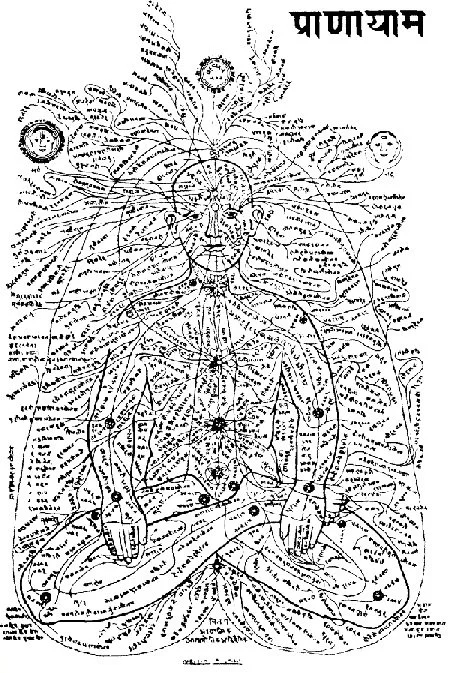
When I started learning about yoga anatomy or the subtle body, this was the biggest mystery to me: how does prana move through our body? This brings us to the nadis.
Nadis are the subtle channels through which prana is understood to flow. You could think of the nadis as an enormous network of roads, allowing prana to reach every little corner of us.
Three are particularly important - like a motorway:
Ida Nadi — associated with lunar, cooling and calming energy
Pingala Nadi — associated with solar, activating and vital energy
Sushumna Nadi — the central channel, associated with balance and spiritual awakening
Ida and Pingala are described as moving upwards and crossing at the different chakra centres. Sushumna moves through the centre of the chakras.
If you have read my article on Vishuddha and Ajna chakra, you may remember how Ida and Pingala meet at Ajna, the eyebrow centre and why these nadis are also relevant to Nadi Shodhana, alternate nostril breathing.
You might have heard that the nadis are often compared with the nervous system. That comparison can help us understand the idea of a communication network running throughout us. Yet the traditional teachings aren't describing physical nerves. You cannot dissect the body and find a nadi.
The nadis belong to another layer of the yogic understanding of the human being: the energy body.
And to understand what that means, we need to zoom out a little and look at the koshas.
One prana. Five jobs to do. Using a humongous road network to get from A to B.
The five koshas: layers of our experience
The idea of the koshas goes back to the Upanishads, ancient philosophical texts that form part of the foundations of yoga philosophy. The Taittiriya Upanishad describes five koshas, usually translated as sheaths.
I find it helpful to think of them as different layers through which we experience ourselves and life.
Annamaya Kosha: the physical body
Anna means food. Annamaya kosha is the body made from food. This is our tangible physical body: the body we can see, touch and measure. It needs food. It needs sleep. It needs movement. It needs physical care. This is perhaps the layer we are most accustomed to thinking about. But yoga doesn't stop there.
Pranamaya Kosha: the energetic body
The next layer is pranamaya kosha. You can see our familiar word prana within it. This is the energetic layer, where we find prana, the nadis, and the chakras. Although we cannot see a nadi like we can see a bone or muscle, we can experience many aspects of our energy.
We notice the breath.
We feel warm or cold.
We experience vitality and depletion.
We feel energy moving or becoming stagnant.
We may notice our hands becoming warmer after practising yoga as mentioned before.
This gives us another layer through which we can observe ourselves.
Manomaya Kosha: thoughts and emotions
Manomaya kosha is associated with the mind, thoughts and emotions. Our experience of life happens here too.
We think.
We worry.
We remember.
We react.
We feel sadness, anger, excitement, fear and love.
And what happens at this layer can affect the other layers.
Anyone who has lost their appetite because they were worried or felt their heart racing before a difficult conversation has experienced how closely these different parts of us interact.
Vijnanamaya Kosha: discernment and understanding
Vijnanamaya kosha takes us into a deeper level of understanding and discernment. I don't think of this simply as whether someone is intellectually intelligent. It is our ability to see more clearly. We begin to recognise patterns, relationships and consequences.
Nature itself is full of rhythm and order. The planets move in their patterns. Day follows night. The seasons come and go. And we too can develop the ability to recognise what supports us, what doesn't, how it affects others, and what response is appropriate.
This quality of discernment also appears when we explore Ajna chakra, the eyebrow centre. There comes a point where we can step back from an immediate thought, feeling or reaction and see something more clearly.
Anandamaya Kosha: the blissful body
The final kosha is anandamaya kosha, often described as the body of bliss.
Here we move towards an experience of joy, contentment and connection that isn't dependent upon everything around us being exactly as we would like it to be.
There is a resonance here with Sahasrara, the crown centre, and the experience of consciousness extending beyond our usual individual boundaries.
These concepts aren't necessarily identical. They point us towards a similar movement: from our everyday individual experience towards something larger.
One prana. Five jobs. A humongous road network. Five layers of experience.
Why do these layers matter?
This is where the koshas become particularly useful for me.
Every yoga session starts with checking in on how everyone feels. And the answer is not just good or bad.
We look at
· how does the body feel,
· how does the breath flow,
· which quality is present in our thinking.
So, we basically check in with some of the koshas, because they give us a more detailed map of our experience.
Imagine that you come to the end of the day and think:
I'm exhausted.
What exactly is exhausted? Your physical body may genuinely need rest. Your energy may need movement. Your mind may have spent the entire day concentrating, making decisions and moving from one task to another.
You may be carrying an emotional experience that hasn't had any space to be processed. We often respond to all of these experiences in the same way: we lie down.
Sometimes that is exactly what we need. Sometimes we lie down and discover that our mind carries on at full speed. The body has stopped moving. The part of us that actually needs attention hasn't.
Perhaps the mind needs a completely different activity. You might need to go outside.
Perhaps you need to move your body instead of lying down.
You might need to breathe differently, deeper, fuller, more rhythmic.
Or maybe you need quiet or to talk to someone.
Or you need to acknowledge an emotion that has been sitting underneath everything else.
Knowing that there are different layers to our experience gives us more places to look.
And that can change how we respond.
So where do the chakras fit into all of this?
The chakras belong within this wider understanding of the subtle body. The Sanskrit word chakra means wheel or circle. They are described as centres within the subtle body through which prana moves and where important nadis meet.
This is one reason I find it limiting when chakras are presented simply as seven coloured circles running up the spine. They belong to a much richer system. They connect with prana. They connect with the nadis.
They connect with different aspects of our physical, energetic, emotional and mental experience.
And the familiar seven chakras are only one part of a much wider history.
Where did the chakra system come from?
The yoga history is never straightforward. Not everything was written down, and the surviving texts don't necessarily give us one unified account.
From my research over the years, there isn't one simple, linear story in which somebody created the seven-chakra system and everyone practised it in exactly the same way from then onwards.
Different traditions developed and worked with subtle-body systems in different ways. There are different numbers of chakras.
The seven centres that have become so familiar in modern yoga are therefore one way of understanding a much larger body of teachings. I find it useful to keep some openness around this.
For this series, I work primarily with the familiar seven-centre model:
Mooladhara lays the foundation of physical life: the body, food, shelter, safety and belonging.
→ Explore the Mooladhara (Root) Chakra
Swadhisthana introduces our emotional world: relationships, creativity, pleasure and our ability to move with change.
→ Explore the Swadhisthana (Sacral) Chakra
Manipura transforms intention into action. It teaches us how to use our inner fire to make purposeful decisions, follow through on what matters and live with greater courage and clarity.
→ Explore the Manipura (Solar Plexus) Chakra
Anahata invites us to reconnect with our heart. Here we cultivate compassion, kindness, forgiveness and the courage to stay open to ourselves and others.
→ Explore the Anahata (Heart) Chakra
Vishuddha helps with communication, expression and purification.
→ Explore the Vishuddha (Throat) Chakra
Ajna develops insight, discernment and the movement of awareness inwards.
→ Explore the Ajna (Eyebrow) Chakra
Sahasrara is pure consciousness, connection and an experience beyond our individual sense of self.
→ Explore the Sahasrara (Crown) Chakra
Each centre gives us another lens through which we can explore ourselves.
One prana. Five jobs. A humongous road network. Five layers of experience. Seven energy hubs.
Kundalini and the movement through the chakras
There is one more concept that belongs to this map: kundalini.
Within these teachings, Kundalini Shakti is traditionally described as dormant energy resting at Mooladhara chakra. As it awakens, it rises through Sushumna Nadi and through the chakra centres towards Sahasrara. This is a vast subject in its own right.
For our purposes here, what matters is that the chakras aren't traditionally understood as seven separate switches that we individually turn on and off.
They form part of a system concerned with prana, consciousness and our development as human beings.
That wider context changes the way I think about "balancing the chakras". It becomes less about deciding that one chakra is blocked and trying to fix it. It becomes an invitation to pay closer attention.
One prana. Five jobs. A humongous road network. Five layers of experience. Seven energy hubs. And one high-voltage current travelling along the central highway.
Bringing the pieces together
We've been building our map as we've gone along. So before we return to everyday life, here it is one more time — this time with all the pieces in place.
Prana is our life energy. It is the life spark that keeps us alive.
The five vayus are five jobs prana performs within the body. They move prana in different directions so it can support breathing, digestion, elimination, circulation and expression.
The nadis are the roads along which prana travels. They form an extensive network of subtle channels so that energy can reach every little corner of our body.
The koshas add layers to our experience, moving from the outside in. We begin with the physical body and move through energy, thoughts and emotions, discernment and finally towards our deepest layer of connection and bliss.
The chakras are energy hubs. They relate to particular aspects of our life and development, from our basic need for safety through relationships, action, connection, expression and discernment towards greater awareness.
Sushumna is the central highway, and Kundalini is the high-voltage current that can travel along it. Kundalini describes the awakening and upward movement of energy through the chakras towards Sahasrara and expanded consciousness.
You don't need to remember every Sanskrit word to make use of this map.
The important part is seeing how everything fits together. We have energy, different functions for that energy, a network that distributes it throughout us, different layers through which we experience life, and energy centres connected with particular aspects of being human.
Together, they give us a much richer way of understanding what is happening within us.
Final Thoughts
The chakras also show us something about how we grow and evolve as human beings.
And this is where the philosophy and the physical practices of yoga complement each other so beautifully.
Yoga teaches us to pay attention.
Through asana, we become more familiar with how our body feels.
Through pranayama, we begin to notice our energy and how quickly the breath can influence it.
Through meditation, we become more familiar with the quality and movement of our mind.
Over time, we learn to recognise these signals more easily.
We might realise sooner that our body needs rest while our mind needs movement. We may recognise that we feel ungrounded before it turns into complete overwhelm. We may notice that our energy has dropped because we haven't eaten, that something needs expressing, or that we already know the answer and need to trust our own discernment.
The philosophy gives us a map. The practices teach us how to read it.
Together, they help us understand what is happening within us sooner, access our own answers more easily and respond with greater confidence.
And for me, that is where these ancient teachings become deeply practical.
One last thought
Well, that was quite a lot to take in.
It took me years to get my head around these concepts, how they relate to each other and why they might be relevant to our lives. I have gone back to the same books and teachings many times, understanding a little more each time.
And perhaps that is how to approach this article too.
The first time you read it, you might simply remember that the vayus or koshas exist. The next time you come across one of those words, you might think, Hold on, I’ve read about that before.
You come back, read it again, and another piece falls into place.
If this subject interests you, bookmark this page and come back to it every now and then. There is no need to take it all in at once.
Ready to create your own road map?
Understanding yourself better gives you more places to look when something feels off. The next step is learning what helps you find your way back.
Back to Rhythm is a 12-week road map for everyday life.
We look at your energy, digestion, sleep, food and daily rhythms, and gradually work out what supports you. You build practical anchors around your own life, so you can recognise what you need sooner and respond with greater confidence.
FAQs
What is the subtle body in yoga?
The subtle body is the energetic aspect of ourselves described in yoga philosophy. It includes concepts such as prana, the nadis and the chakras. The koshas give us an even wider framework, showing how our experience moves from the physical body through energy, mind and emotions, discernment and deeper awareness.
What is the difference between prana, nadis and chakras?
Prana is our life energy. The nadis are the network of subtle channels through which prana travels, allowing energy to reach throughout the body. The chakras are energy centres or hubs where important nadis meet and are associated with different aspects of our physical, emotional, mental and spiritual development.
Or, using our map: prana is the energy, nadis are the roads, and chakras are the hubs.
Are there only seven chakras?
No. Different yogic, Tantric and Buddhist traditions describe different chakra systems and different numbers of chakras. The seven-chakra model commonly used in modern yoga is one system within a much larger body of subtle-body teachings.
How can understanding the subtle body help in everyday life?
The subtle-body teachings give us more ways to understand what we are experiencing. Feeling tired, for example, can involve physical fatigue, depleted energy, mental overload or emotional exhaustion. Yoga practice helps us become more familiar with these different signals. Over time, this can help us recognise what we need sooner and respond with greater clarity and confidence.