The Higher Chakras: From Expression to Inner Awareness

Last updated: August 2026
TL;DR
The higher chakras take us from expression and communication towards discernment, inner awareness and consciousness.
Vishuddha, the throat chakra, is connected with communication, listening, sound, expression and purification. Practices such as mantra, humming, Bhramari and conscious communication can help us explore its qualities.
Ajna, the third eye chakra, is associated with concentration, discernment, wisdom and intuition. Drishti, Trataka, Nadi Shodhana and meditation help us learn to steady our attention and gradually turn it inwards.
Sahasrara, the crown chakra, represents the culmination of the chakra journey and our movement beyond the individual sense of self towards pure consciousness.
As we move through the chakra system, the practices become increasingly subtle. The lower chakras remain an essential part of the journey as their qualities are gradually integrated and refined.
Chakra practices traditionally develop progressively. Simple asana, pranayama, mantra, concentration and meditation give us plenty to explore without trying to force a chakra to “open.”
Prefer to listen?
You can press play below to hear this episode of Rooted in the Seasons, or scroll down to read the blog post.
Do you remember where we came from?
All the way down at the base, with the Mooladhara (Root Chakra), connected with our foundations — our life, health, home and basic needs.
From there, we travelled upwards towards the Swadhisthana (Sacral Chakra), connected with our emotional life and desires.
Then we reached Manipura (Solar Plexus Chakra), our transformation centre. Here, we begin to transform our primal energy into action, direction and willpower.
At Anahata (Heart Chakra), something begins to shift. Our attention starts to move outwards. We become more aware of connection, compassion and our relationship with others.
As we move higher through the chakra system, the teachings and practices become increasingly subtle.
With Vishuddha Chakra, we explore expression, communication, listening and sound.
With Ajna Chakra, we move towards concentration, discernment and inner awareness.
And as we continue this ascent, Sahasrara Chakra is not so much a final destination as a development that begins long before we arrive there. It is something that unfolds gradually through the entire journey, becoming more apparent as the lower chakras are integrated and refined.
Of course, each of these chakras could fill an entire blog post — or a book. So, this is an introduction to some of their main qualities and a few practical ways we can explore them through yoga.
Vishuddha Chakra — Expression, Communication and Purification

From the heart centre, we move upwards to the throat centre.
The word shuddha means clean or pure, in the sense of cleansing and purifying. Vishuddha is located around the throat area, between the heart and the head. It is associated with the ether element, and its bija mantra is HAM.
Traditionally, Vishuddha is represented as a flower with 16 petals surrounding a dark blue centre. Each petal is associated with a Sanskrit sound and a particular quality. These qualities are fascinating because they give us a much fuller picture of Vishuddha. They include compassion, forgiveness, poison, straightforwardness, self-control, pride in our roots, sacrifice, personal pride, nectar, calmness, happiness, vocal expression, vanity, noble nature, truthfulness and knowledge.
Some of these qualities may seem surprising when we think of the throat chakra simply as our centre of communication.
But Vishuddha is also a centre of purification. We find both poison and nectar. Pride as well as noble nature. Vanity as well as truthfulness. The qualities describe something of the process that takes place here as our experiences, thoughts and impulses become increasingly conscious and refined.
Vishuddha governs speech and hearing and is closely connected to communication. But communication is only part of the picture.
Vishuddha is also connected with how we express ourselves.
Our ideas.
Our thoughts.
Our creativity.
Our knowledge.
Our inner experiences.
One of its 16 qualities is even vociferation — the power of strong, clear vocal expression and chanting.
In the Ṣaṭ-Cakra-Nirūpaṇa, Sadā-Śiva resides within Vishuddha as the male deity, together with Śākinī, the Shakti or female deity of this chakra. The text also connects Vishuddha with Haṃsa, the swan.
Although Saraswati isn't directly named here, I couldn't help noticing the connections as I reread the traditional description of Vishuddha. Haṃsa is also traditionally Saraswati's vehicle. Saraswati is the goddess of knowledge, speech, music, learning and the creative arts.
Perhaps I noticed this particularly because Saraswati has been the focus of our yoga sessions this term.
We often describe Vishuddha as our centre of communication. Through Saraswati, we can see it more widely as a centre of expression.
We express ourselves when we speak.
We express ourselves when we write.
We can express ourselves through music, art, movement, teaching and creativity.
Something that exists within us is given a form through which it can enter the world. And then there is the way in which we use our words.
Saraswati likes sweet words. This doesn't mean that we only say pleasant things or avoid difficult conversations. It asks us to become more conscious of how we speak.
Yoga teaches us to speak truthfully while also considering the effect our words have on others. This brings together satya, truthfulness, and ahimsa, non-harming.
We can begin to notice:
Is what I am saying true?
Do I need to say it?
How am I saying it?
Do my actions live up to my words?
Vishuddha is also connected with listening.
During a conversation, are we really listening to the other person?
Or are we already preparing what we are going to say next?
Communication moves both ways.
Vishuddha as a Centre of Purification
The meaning of Vishuddha takes us beyond simply "finding our voice." It is a centre of purification. Traditionally, Vishuddha is described as having the ability to purify difficult or poisonous experiences so that they can be absorbed and transformed.
There is another interesting connection here with Shiva. Shiva is also known as Neelakantha, the blue-throated one. In the story of the churning of the ocean, a deadly poison emerges. Shiva takes the poison to protect the world and holds it in his throat, which turns blue.
This gives us another way of understanding Vishuddha as a place of purification.
Difficult experiences don't simply disappear. We learn to hold them, process them and gradually transform our relationship with them. Perhaps this is also why we find both poison and nectar among the qualities of Vishuddha.
We experience something.
We process it.
We find a way to understand and express it.
Over time, experiences that once felt difficult may become something we can speak about, write about, teach from or even transform into something creative. This is one of the reasons conscious speech is considered so important when working with Vishuddha. We are encouraged to avoid gossip and careless speech and to make sure our actions live up to our words.
Practices for the Vishuddha Chakra
There are several simple ways we can explore Vishuddha in everyday life.
Notice how you communicate
Pay attention to the way you speak during ordinary conversations.
Notice what happens when you are tired, irritated or in a hurry.
Practise listening fully when somebody else is speaking.
You can also use journaling or free writing to express thoughts, ideas and plans that may still be taking shape.
Use sound
Sound is particularly important for Vishuddha.
Chanting and mantra are another way of working with sound. HAM is the bija mantra associated with Vishuddha. In the teaching I received, however, we were taught not to chant HAM on its own. I'll explain why when we reach Ajna chakra.
Bhramari, the humming bee breath, is another lovely way to explore sound and vibration.
Yoga and breath
Yoga practices traditionally associated with Vishuddha include:
Neck movements
Matsyasana — Fish Pose
Simhasana — Lion Pose and Lion's Breath
Sarvangasana — Shoulder Stand
Halasana — Plough Pose
Ujjayi breathing
Bhramari breathing
You certainly don't need to practise all of these.
Even spending a few minutes humming, chanting or consciously listening can bring your attention to this aspect of the chakra system.
🌱Creating space for yourself in everyday life can change how much capacity you have for connection, patience and care.
You can download my free guide:
5 Daily Ayurvedic Shifts to Feel Like Yourself Again
It walks you through how to apply this practically.
Ajna Chakra — From Looking Outwards to Looking Inwards

From Vishuddha, we continue upwards towards Ajna.
Ajna can be translated as order or command, which is why it is sometimes called the command centre. It is also known as the guru chakra.
Ajna is located around the eyebrow centre and is often known as the third eye chakra.
Ajna has two petals bearing the letters Ha and Kṣa and is described as the seat of mind, or manas. In the teaching I received, Ajna is dark blue, the blue of space. Interestingly, the Ṣaṭ-Cakra-Nirūpaṇa describes Ajna as beautifully white, like the moon, showing how representations can vary between texts and traditions.
I particularly like another description from the same text: Ajna “shines with the glory of Dhyana” - meditation.
Ajna is connected with judgement, rationality, wisdom, concentration and intuition. But I think one of the most useful ways of understanding Ajna is through discernment.
Can we see clearly?
Our first reaction to something isn't always the clearest one.
Our thoughts are influenced by previous experiences, emotions, habits, fears and desires. This is where discernment comes in: learning to look through those old thought patterns to understand more clearly what is best for ourselves or others. Something can feel very strong without necessarily being intuition.
As the mind becomes steadier, we have more space to observe what is happening. We can begin to distinguish between an immediate reaction and something we understand at a deeper level. This is where concentration becomes important.
Where the Eyes Go, Attention Follows
One of the simplest ways to understand this is through the gaze. Where the eyes go, attention follows. You can experience this very easily in a yoga practice.
Try standing in Tree Pose while allowing your eyes to move around the room; notice how steady you feel. Then choose one steady point in front of you and rest your gaze there. Usually, something changes. The gaze becomes steadier. Your attention becomes steadier. And often, your body becomes steadier too.
In yoga, we call this steady point of focus drishti. The physical gaze gives us a practical way of exploring something that becomes increasingly subtle as we move towards Ajna. We learn to place our attention. And eventually, we begin turning that attention inwards.
Nadi Shodhana and the Ajna Chakra
One of the most accessible practices for exploring this is Nadi Shodhana, alternate nostril breathing.
To understand why, we need to touch briefly on the subtle body. In the traditional yogic model, nadis are channels through which prana, our vital energy, flows. Three of the most important are Ida, Pingala and Sushumna. Ida and Pingala weave alongside the central channel, Sushumna, meeting at various points associated with the chakras.
At Ajna, they meet for the last time, before moving to their respective endpoints at the outside of the nostrils. Ida and Pingala are associated with calm and activity, moon and sun. Sushumna stands for balance.
Nadi Shodhana cleanses the nadis and helps to balance these channels, which is why it is such an appropriate practice here.
There is much more to the nadis, prana and the subtle body than we can cover in one section. Understanding them also helps the whole chakra system make considerably more sense.
Other Practices for Ajna
Other traditional practices work with concentration and the gaze.
Drishti teaches us to place our gaze steadily during an asana practice.
Trataka, or candle gazing, involves holding the gaze steadily on a candle flame and is traditionally used as a concentration and cleansing practice.
Sound also appears again at Ajna. There is something interesting here when we look at the petals of the chakras. We started with four petals at Mooladhara. Vishuddha has 16, as we have just seen. Ajna has only two, associated with the sounds HAM and KSHAM.
My teacher taught us to always chant these two together, rather than chanting HAM on its own. If we remember the qualities associated with Vishuddha, they include pride and vanity alongside truthfulness, compassion and knowledge. Ajna brings in discernment and greater awareness, helping to keep these qualities in check.
This is another reminder that the chakras are part of a system. Taking one chakra or one practice completely in isolation can mean missing how the different centres work together.
Meditation takes this process further as our attention gradually turns away from constant external stimulation and towards our inner experience. Patanjali approaches meditation through a different framework, but the practice of learning to steady and direct our attention gives us another way to understand what we are exploring here with Ajna.
If you'd like to go deeper into this, I wrote more about Why meditation matters and how it fits into Patanjali's eight limbs of yoga.
The practices are becoming quieter now.
That reflects where we are in the chakra system.
Sahasrara Chakra — The Crown of the Chakra System
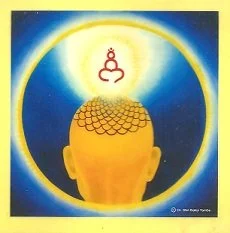
Finally, we reach Sahasrara, the culmination of the entire journey through the chakras.
Rather than being understood as a single endpoint, Sahasrara is a development that arises naturally as awareness is refined through the work with the lower centres. In this sense, Sahasrara is not something we suddenly arrive at. It gradually reveals itself as awareness becomes more refined and less identified with the individual sense of self.
Sahasrara is located at the crown of the head and is traditionally represented by the thousand-petalled lotus. It is associated with pure consciousness and moving beyond our individual sense of self.
The foundations of Mooladhara, the emotions of Swadhisthana, the transformative power of Manipura, the compassion of Anahata, the expression of Vishuddha and the discernment of Ajna have all brought us here. Sahasrara is the revelation of all of this — the deeper awareness that has been maturing throughout the entire path.
It is difficult to reduce this chakra to a list of practical exercises because the teachings associated with it point towards states of consciousness that develop through sustained spiritual practice.
Meditation naturally becomes increasingly important as we reach this stage of the chakra journey.
Working With the Chakras Gradually
The higher we move through the chakra system, the more subtle the practices become.
This is also where I think it is important to remember that traditionally, chakra practices were never about trying to force a chakra to "open."
Yoga gives us practices through which awareness, steadiness and sensitivity can develop gradually. The nervous system also needs time to become more resilient and able to hold the effects of these practices.
Earlier, when we explored Ajna, we saw how the body and attention follow the gaze. We can think about energy in a similar way. Energy flows towards what is already active within us. If anger, fear, selfishness or the need for recognition are dominant, more energy can strengthen those tendencies. As we gradually work with and transform these patterns, that same energy can support compassion, clarity, discernment and a greater awareness of others.
This is one reason the journey through the chakras matters. We don't simply leave the lower chakras behind as we move upwards. Their qualities continue to be integrated and refined.
Simple asana, Nadi Shodhana, Bhramari, mantra, concentration and meditation give us plenty to explore safely in our everyday practice. These practices help prepare the body, mind and nervous system over time.
If you would like to explore mantra as part of your chakra practice, this short guided meditation takes you through the chakras using their Bija, or seed, mantras. We first work with each chakra individually before moving through the sounds as a continuous practice. Chant with me here
More advanced practices involving Kundalini, strong pranayama, bandhas and mudras are traditionally learned progressively and with the guidance of an experienced teacher.
There is no need to rush. The preparation is part of the practice.
From the Root to the Crown
When we look at the chakra system as a whole, we can begin to see why each chakra makes more sense as part of a journey. It is also a journey through the evolution of human awareness.
We begin at Mooladhara with our most basic needs: survival, safety, health, home and the foundations of our physical life.
At Swadhisthana, we encounter our emotions, desires and what brings us pleasure.
At Manipura, we develop our sense of self, our willpower and our ability to act and transform.
These lower centres are essential. They give us the foundations from which everything else can develop. And we have a choice about what we do with them. We can remain primarily concerned with our own security, desires, achievements and needs. Or we can continue to develop our awareness and begin to recognise that our lives are connected with something larger than ourselves.
At Anahata, this shift becomes particularly apparent. Our awareness expands towards love, compassion and our relationship with others.
At Vishuddha, we learn to express what is within us. We find our words, our creativity, our knowledge and our own way of contributing to the world.
At Ajna, we develop greater discernment. We learn to see through some of our habitual reactions and patterns, direct our attention and listen more closely to our inner wisdom.
And through Sahasrara, the teachings take us beyond our individual sense of self towards consciousness itself.
Seen in this way, the chakra system gives us a map of what it means to become a more aware and conscious human being. We still need our roots. We still have emotions, desires, ambitions and individual needs. As our awareness develops, we have greater choice in how we respond to them and what we do with the energy they contain.
We can care about the people around us and the environment we live in.
We can express ourselves more truthfully and creatively.
We can make choices with greater clarity.
And gradually, we can become more conscious of who we are, how we affect the world around us and the life we are here to live.
Perhaps this is why understanding the chakras takes time. They form part of a much larger yogic understanding of the body, mind, prana and consciousness.
The more we understand how the pieces connect, the more the whole journey begins to make sense. And this is also where these ancient teachings become very practical.
Becoming more aware of our patterns is one thing. Learning how to make different choices in the middle of everyday life takes practice.
This is something we explore in Back to Rhythm — learning to understand the signals your body is giving you, recognise the patterns that keep pulling you out of rhythm, and gradually build a way of living that supports your energy, digestion, sleep and emotional balance.
If you'd like to explore this more deeply, you can join the Back to Rhythm Interest Listhere.
Source: Sir John Woodroffe (Arthur Avalon), The Serpent Power: The Secrets of Tantric and Shaktic Yoga, including his translation and commentary on the Ṣaṭ-Cakra-Nirūpaṇa.
All chakra images painted by Shri Balaji Tambe.
FAQs
What is the Vishuddha chakra?
Vishuddha is the throat chakra and is associated with communication, listening, sound, expression and purification. The word shuddha means clean or pure, in the sense of cleansing and purifying. Its traditional symbolism includes 16 petals, each connected with a Sanskrit sound and a particular quality.
What is the Ajna chakra?
Ajna is located around the eyebrow centre and is often called the third eye or command centre. It is associated with the mind, concentration, judgement, wisdom, intuition and discernment. One of the most useful ways to understand Ajna is through our ability to see more clearly beyond our immediate reactions, habits and old thought patterns.
Why is Saraswati associated with the Vishuddha chakra?
Saraswati is the goddess of knowledge, speech, music, learning and the creative arts, making her qualities closely connected with expression and communication. Although Saraswati is not directly named as residing within Vishuddha in the Ṣaṭ-Cakra-Nirūpaṇa, the text connects Vishuddha with Haṃsa, the swan, which is traditionally Saraswati's vehicle.
Why is Shiva associated with the throat chakra?
The Ṣaṭ-Cakra-Nirūpaṇa places Sadā-Śiva within Vishuddha. There is also an interesting connection with the story of Shiva as Neelakantha, the blue-throated one. Shiva holds the deadly poison that emerged during the churning of the ocean in his throat. This offers a useful way of understanding Vishuddha's association with purification and the transformation of difficult experiences.
Why is Nadi Shodhana connected with Ajna?
In the traditional subtle-body model, Ida and Pingala meet at Ajna before moving towards their respective endpoints at the nostrils. Nadi Shodhana, or alternate nostril breathing, cleanses the nadis and helps balance these channels. This makes it a particularly relevant and accessible practice for exploring Ajna.
What is the Sahasrara chakra?
Sahasrara is the crown chakra, traditionally represented by the thousand-petalled lotus. It is associated with pure consciousness and moving beyond our individual sense of self. It can be understood as the culmination of the development taking place throughout the chakra journey.
Can you open or activate the higher chakras?
Traditional chakra practice is a gradual process. Yoga practices help develop awareness, steadiness, sensitivity and nervous-system resilience over time. Simple practices such as asana, Nadi Shodhana, Bhramari, mantra, concentration and meditation offer accessible ways to explore the chakras. More advanced Kundalini practices, strong pranayama, bandhas and mudras are traditionally learned progressively with an experienced teacher.