Late Winter Yoga: A Grounding Sequence for the Shift from Vata to Kapha
TL;DR
Late winter is a transitional season.
Vata begins to move into Kapha, meaning the body still needs warmth — but energy may feel either depleted or sluggish.
This short sequence focuses on:
Warming without exhaustion
Building strength without rigidity
Adapting pace depending on how you feel
Three to five rounds of Surya Namaskar may already be enough.
The key is not duration — it’s responsiveness.
Late winter is a sensitive time of the year.
It’s still cold — but something begins to shift.
This morning, when I walked the dog, the sun was bright and already quite warm. Two days ago, we still had that freezing wind. I find these sudden ups and downs in temperature rather tiring.
It reminded me why Ayurveda suggests extra care during times of transition.
In Ayurveda, this is the time when Vata slowly begins to move into Kapha.
Both share the cold quality — so warmth is essential.
But energetically, they sit on opposite sides of the spectrum.
Vata is light, sometimes depleted, and easily exhausted.
Kapha is slow, heavy, and sometimes stagnant.
One needs steadiness and containment.
The other needs activation and heat.
So how do you practise when both qualities are present in the body?
You warm the body.
But you don’t exhaust it.
You build strength.
But you don’t harden.
Late winter doesn’t demand peak performance.
It asks for intelligent adjustment.
And most importantly, you check in first.
Start With a Check-In
Even at home.
Sit for a few minutes and notice:
How do the joints feel?
Is there fluidity or stiffness?
Do you feel overall strength — or fragility?
Is the breath full?
Sometimes we think we know how we feel. But when we actually sit down and look into the body — into muscles, joints, breath — the answer can be different.
Honesty matters more than ambition. What you notice when you check in gives you the information you need — not for an ideal practice, but for the one your body needs today.
Surya Namaskar – A Complete Practice

Surya Namaskar is excellent all year round.
On days when time is short, this can be your entire practice.
Three to five rounds already have a significant effect. It works across systems — circulation, digestion, breath, strength, coordination. It balances and integrates the body.
For Vata-dominant days:
Move slightly slower.
Hold each posture for one full breath.
Emphasise grounding through the feet.
Focus on strength and stability in each position.
Avoid rushing transitions.
For Kapha-heavy days:
Bring in a little more speed.
Create rhythm.
Build heat consciously.
Let the breath be strong and steady.
Same sequence.
Different intention.
That’s the beauty of it — it adapts.
If you’re new to Surya Namaskar, or simply prefer practising with guidance, you’ll find a full step-by-step tutorial here.
And if you’re curious why Surya Namaskar can be a complete practice in itself, I’ve written (and recorded) a deeper explanation here.
Tadasana to Uttanasana – Opening the Back Body

Tadasana
→ Uttanasana
From standing:
Inhale — lengthen.
Exhale — fold forward.
Let the breath travel down the back of the body, into the lower ribs, into the abdomen.
With each out-breath, gently draw the navel back.
This reinforces core strength and supports digestion — important as Kapha begins to rise.
For Kapha, you have two options:
Work dynamically: half lift on the inhale, fold on the exhale (Sun Breath variation).
Or stay in the pause and work more strongly with the exhale, drawing the navel back more firmly each time.
“Creating rhythm” here doesn’t mean fast. It means intentional, active.
For Vata:
Move steadily. Let the fold calm the nervous system.
If the lower back feels sensitive, soften the knees and stay within a range that feels steady and supported.
Warrior I – Stability for Vata, Heat for Kapha
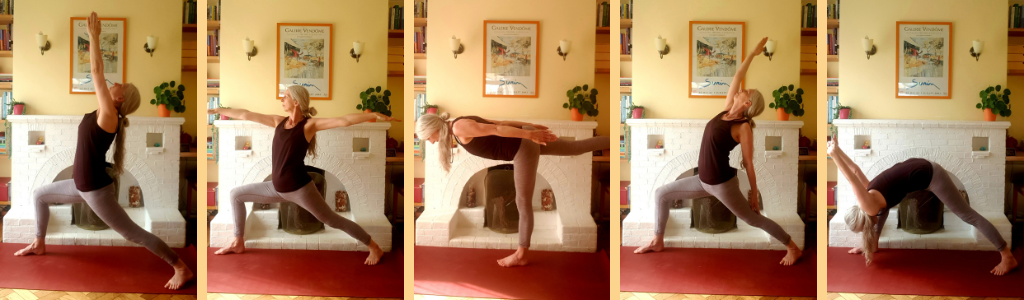
Step forward into Warrior I.
Front knee over ankle — not further.
Back heel anchors.
Hips align forward as much as possible — front hip bones pointing ahead.
Lengthen up through the spine.
Open through the front of the back leg.
Lift the arms with that side of the body to assist the opening.
For Vata:
Focus on grounding through the feet.
Feel stability in the legs up into the hips.
Keep the gaze forward.
Contain energy.
For Kapha:
Let heat build through deeper breathing into the abdomen, gently drawing the navel back on each exhale.
Lift the gaze slightly toward the ceiling.
Lengthen away from the grounded base into space.
Create upward movement.
Optional variation:
From lifted arms, exhale and sweep the arms down and around.
Interlock fingers behind the back.
Extend the arms.
Create an even arch through the spine.
Draw the lower ribs slightly inward.
Lengthen before arching.
Open the upper chest.
This supports both:
Kapha through chest opening and stimulation.
Vata through controlled strength and even extension.
Change sides.
Warrior II – Strength With Breath
Virabhadrasana II
Open into Warrior II.
Ground evenly through both feet.
Distribute weight evenly.
Arms extend at shoulder height.
Top of the shoulders remain relaxed.
Lengthen through the crown of the head.
Let the pelvis find a natural position — don’t force.
For both Vata and Kapha:
Breathe deeply down toward the navel.
On each exhale, draw the navel gently back.
Hold for no more than five breaths.
Strong. Stable. Warm.
Transition to the Floor

Inhale — lift the arms.
Exhale — fold forward.
Step back into Downward-Facing Dog Adho Mukha Svanasana.
Stay for five breaths.
Lengthen through:
The waist
The underarms
The arms
Send the hips back.
Gaze toward the thighs or navel.
Let the whole body feel long and warm.
Mermaid Twist – Gentle Warming Rotation
From Down Dog:
Lower knees to the ground.
Draw the right foot forward toward the left knee.
Place the right hand next to the right thigh for support.
Carefully sit down next to the right foot.
Right hand behind you.
Left hand on right knee.
Look over the right shoulder.
Breathe into the diagonal space between right shoulder and left knee.
Stay long through the waist.
This gently warms the spine.
Supports digestion.
Opens breathing space.
Mobilises joints without overstimulation.
Change sides.
Bridge Pose – Integrate
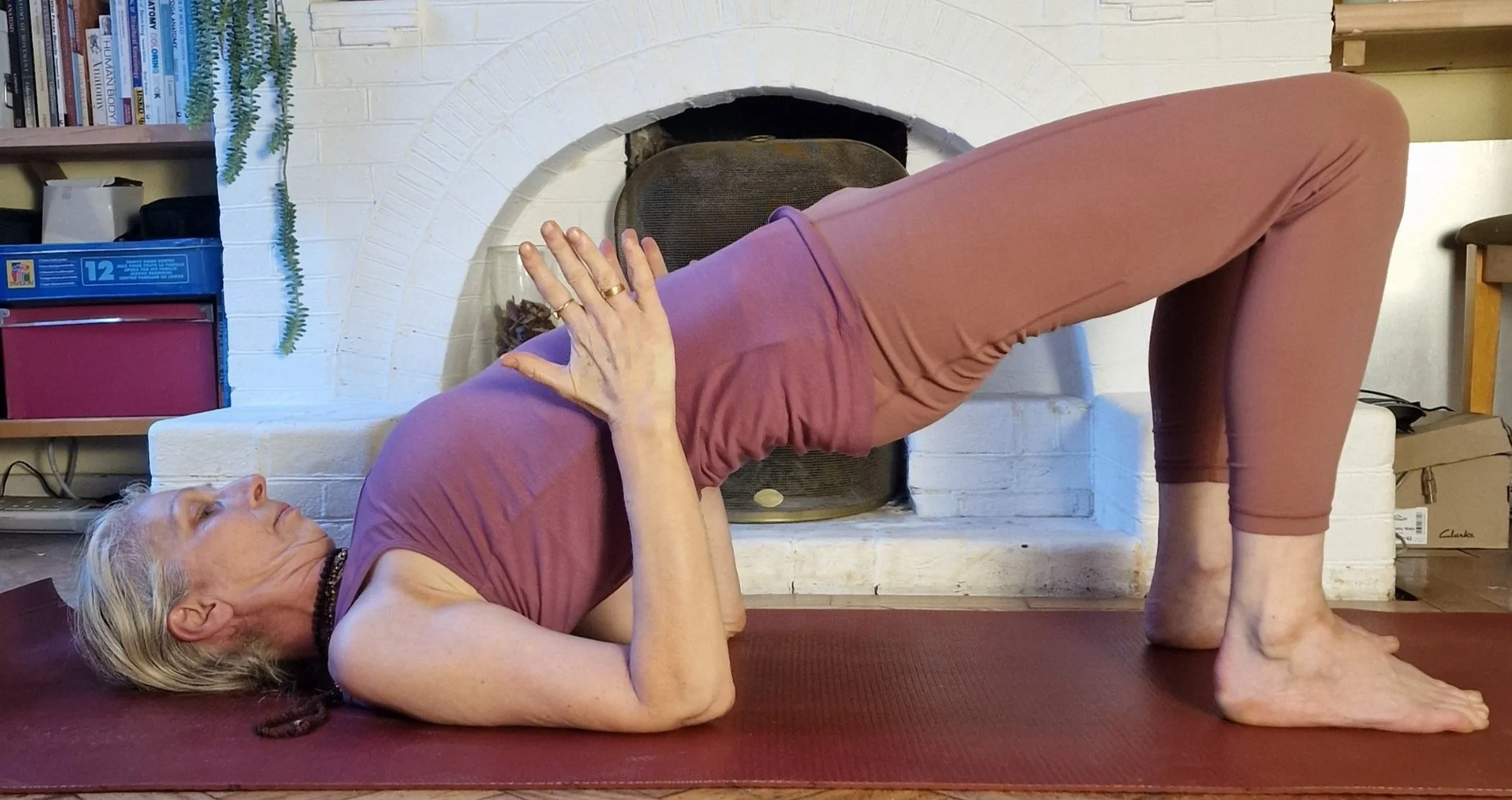
From the mermaid twist, stretch both legs out in front of you and roll slowly onto your back.
Feet grounded.
Press through the legs.
Lift the pelvis.
Lengthen before arching.
Draw lower ribs slightly inward.
Open the chest evenly.
Keep pressing the floor away with your arms and feet. Breathe into the front body and, with the outbreath, feel the strength of your back body.
For Kapha:
Stimulates circulation and energy.
For Vata:
Creates grounded stability through the legs.
Optional Finish

The best at the end.
If you are familiar with Shoulder Stand and the energy is steady, you may move into it after Bridge Pose. Lift the knees toward the chest on an inhale, then extend the legs upward with the exhale.
Or choose Viparita Karani, placing a folded blanket or cushion under the pelvis for gentle support.
Choose based on time, energy, and experience.
This is not the moment to attempt something new — only to deepen what already feels stable.
Final Rest
This final rest is not an afterthought. It is where the practice settles.
Three to five quiet minutes can make the difference between feeling grounded and calm — or stepping straight back into rushing mode.
Lie on your back with knees bent and feet grounded.
Or take a gentle supine butterfly.
Breathe slowly.
Let warmth settle.
Let effort integrate.
Allow the body to absorb what you have just created.
Late Winter Is Not About Pushing
It’s about warming without exhaustion.
Strengthening without rigidity.
Moving without losing steadiness.
Late winter can feel confusing — the light is returning, but your energy may not have caught up yet.
Three to five rounds of Surya Namaskar may already be enough.
A steady Warrior.
A few conscious breaths.
The key is not duration.
It’s responsiveness.
And responsiveness builds resilience — quietly, steadily — for the season ahead.
Explore These Poses in More Detail
FAQs
1. Is late winter a Vata or Kapha season?
Late winter is a transitional time. Vata is still present, but Kapha begins to rise as the weather becomes heavier and more damp. This means the body may feel either slightly depleted (Vata) or sluggish (Kapha), sometimes even both.
2. Should I practise slower or faster in late winter?
It depends on how you feel that day.
If you feel tired, cold, or fragile, practise more slowly and steadily to conserve energy.
If you feel heavy, dull, or unmotivated, increase pace slightly and build gentle heat.
3. Is Surya Namaskar enough as a full practice?
Yes. Three to five mindful rounds of Surya Namaskar can be a complete practice, especially during busy weeks. It works across systems — breath, strength, circulation, and coordination — and can be adapted to your energy levels.
4. What if forward folds feel uncomfortable in my lower back?
Soften the knees and reduce the depth of the fold. The posture should feel supportive and steady — not strained. Practising within your current capacity is always more beneficial than pushing further.
5. Do I need to do Shoulder Stand at the end?
No. Shoulder Stand is optional and only suitable if you are already familiar with it. Legs up the wall is a gentle alternative that offers similar calming benefits.