Swadhisthana Chakra: Emotions, Creativity and the Flow of Life

updated July 2026
TL;DR
In this episode, we explore the Sacral Chakra (Swadhisthana) through the traditional teachings of yoga. Discover what this energy centre can teach us about emotions, creativity, relationships and learning to move through life's changes with greater awareness. You'll also learn simple practices, including the VAM mantra, meditation and yoga poses, to cultivate emotional balance in everyday life.
“Meditation on the pure lotus, which is named Swadhisthana, frees you from the control of your enemies, such as egoism, ignorance, lust and greed.””
Prefer to listen?
You can press play below to hear this episode of Rooted in the Seasons, or scroll down to read the blog post.
Have you ever watched someone do something you have quietly wanted to do yourself?
Perhaps a colleague leaves her secure job to follow a different path. You are pleased for her. At the same time, something inside you tightens.
There may be envy, regret or a sense of being left behind. Her decision has touched a desire that you have carried without acting upon.
Experiences like this bring us into the realm of the Swadhisthana chakra.
In the previous article, we explored the Mooladhara chakra and the foundations of physical life: the body, food, shelter, safety and belonging.
As we move one step higher to Swadhisthana, our emotional life enters the chakra journey. Here we encounter desire, pleasure, attachment, creativity and the feelings that arise through our relationships with other people.
Swadhisthana is associated with the water element. Water moves, responds and changes shape. This gives us a useful image for our own ability to experience emotions, adapt to change and continue moving through life.
In this guide, we’ll explore the traditional symbolism of the Swadhisthana chakra, its connection with emotions and relationships, and practical ways to work with its themes through yoga, breath and reflection.
What is the Swadhisthana Chakra?
Swadhisthana is the second of the seven main chakras. It is located in the pelvic region, close to the Mooladhara chakra at the base of the spine. In English, it is commonly called the sacral chakra.
The Sanskrit name can be translated as “one’s own dwelling place”:
swa means self or one’s own
adhisthana means dwelling place, seat or foundation
As mentioned earlier, Swadhisthana is traditionally connected with the water element. Its symbol contains an upward-facing silver-grey crescent moon surrounded by six orange-coloured petals.
Each petal carries a Sanskrit sound:
baṁ, bhaṁ, maṁ, yaṁ, raṁ and laṁ
These six sounds are distinct from VAM, the bija or seed mantra associated with the chakra.
Mooladhara is connected with the sense of smell. Smell helps us recognise what is safe and supports the basic preservation of physical life.
Swadhisthana introduces the sense of taste. This includes our physical experience of flavour and the wider idea of developing a taste for life: what we enjoy, desire and feel drawn towards.
Swadhisthana and Our Emotional Life
As the second chakra, Swadhisthana introduces the emotional layer of our development.
Its themes include pleasure, desire, creativity, self-expression and our relationships with other people. It also offers a framework for exploring the emotions those relationships awaken within us.
The reaction in our opening example shows how desire can surface as envy, jealousy or a sense of being left behind. Someone else’s decision brings our own unexpressed longing into view.
These emotional patterns begin early in life. A child may feel possessive about a parent, friend or favourite toy. As we grow older, similar feelings appear within friendships, partnerships and working relationships. The circumstances change, while the underlying fear of losing something important can remain.
These feelings often touch an existing insecurity. When we question our own worth, we may assume that other people are questioning it too. We can begin comparing ourselves with someone we perceive as more attractive, successful, intelligent or confident.
Some of these feelings remain beneath the surface. Swadhisthana invites us to recognise them and find healthy ways to express what we feel.
Through this chakra, we begin to understand our emotions as part of our experience. They can reveal what we value, what we fear losing and what we may be longing to explore.
The Water Element: Emotions, Flow and Adaptability
Swadhisthana’s connection to the water element gives a useful way to understand flow and adaptability.
Water moves, changes shape and finds its way around obstacles. It offers an image for emotional flexibility: our ability to experience a feeling, respond to what is happening and continue moving through life.
Sometimes we feel in flow. Our energy moves naturally towards relationships, ideas and experiences that matter to us.
At other times, we feel stuck. We may hold tightly to a familiar situation, suppress what we feel or repeatedly return to the same disappointment. The desire revealed in the opening example remains present, yet fear may keep us from acting on it.
Adaptability supports resilience. It helps us respond to changing circumstances and recover after stressful experiences.
A river also needs banks to guide its movement. In everyday life, our daily rhythms can provide those banks.
Consistent mealtimes, regular sleep, movement and familiar routines give the body a steady structure. From that foundation, we have more capacity to meet change without becoming overwhelmed by it.
This is one of the places where the teachings of yoga and Ayurveda meet. You can explore this further in How the Doshas Respond to Stressor through my free guide, My5 Quick Ayurvedic Fixes to Move from Scattered to Steady.
The Deities and Symbols of Swadhisthana
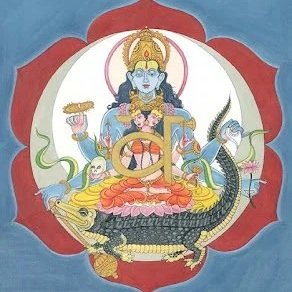
The traditional image of Swadhisthana brings several aspects of its teaching together.
Within the six-petalled lotus and silver-grey crescent, we find Lord Vishnu, the sustainer of balance. The image also contains Makara, the mythical aquatic crocodile, the vehicle of Varuna, the deity of water and oceans.
Rakini Devi is the presiding goddess of Swadhisthana. She is less familiar in the West than many other goddesses. Within the tantric tradition, she is described as an empress and often appears with two heads.
In The Essential Guide to Chakras, Swami Saradananda describes Rakini as holding:
“…the key to maintaining a healthy balance between stability and flow.”
This balance lies at the heart of Swadhisthana. Rakini represents the capacity to release fantasy while remaining connected to our dreams. She also teaches discernment around pleasure and desire.
Desire can show us what we long to experience or create. Restraint helps us choose how to respond to that desire. Together, they allow emotional energy to move in a constructive direction.
I think I need to keep Rakini close. Perhaps we all do.
A healthy life needs both: steady foundations and the capacity to move when life changes. Too much movement leaves us ungrounded. Too much stability can become rigidity.
The balance between stability and flow may be one of the simplest descriptions of well-being.
The Journey of Energy
Before we explore some practical ways to work with Swadhisthana, there's one important principle that helps us understand the chakra journey as a whole.
Energy follows the same path.
As our yoga practice develops, more energy is generated. Many people notice they simply have more energy available than they did before.
That energy naturally moves into whatever foundation is already there.
If the body and nervous system are well prepared, it supports greater steadiness, clarity and awareness. If we try to generate more energy before creating a stable foundation, it can simply amplify whatever is already present, including restlessness, fear or emotional agitation.
This is one reason yoga begins with Mooladhara. We first establish stability at the root. From there, the energy naturally moves into the themes of Swadhisthana: our emotions, relationships, creativity and capacity to adapt to change.
With that understanding, let's explore a few simple practices.
Practices for Exploring Swadhisthana
As I explained in the Mooladhara article, deeper work with the chakras belongs under the guidance of an experienced teacher.
The following practices offer a simple way to explore the themes of Swadhisthana in everyday life.
Reflection
Choose one question and allow yourself time to write without trying to reach an immediate conclusion:
Where in my life do I feel most alive and in flow?
Where do I currently feel stuck?
What does envy reveal about something I want for myself?
Do I allow space for happiness, pleasure and enjoyment?
How do I express difficult emotions within my relationships?
Where would a clearer boundary support me?
What gives me stability when life changes?
Which dream needs practical action?
Which expectation may need to be released?
These questions may bring desires, insecurities and emotional patterns into greater awareness. Approach whatever arises with curiosity and kindness.
Feeling stuck can sometimes reflect depleted energy, disrupted daily rhythms or a nervous system carrying too much. Restoring one reliable anchor may create enough stability for movement to begin.
Meditation with VAM
Sit comfortably and allow your spine to lengthen. Relax your shoulders and rest your hands somewhere comfortable.
Close your eyes or lower your gaze.
Bring your awareness to the centre of the pelvis. Visualise a silver-grey crescent moon resting there.
Take a few natural breaths.
Begin to chant:
AUM VAM
AUM VAM
AUM VAM
Feel the vibration of the sound and continue for as long as your attention remains comfortable.
When you are ready, allow the chant to end. Sit quietly and notice any physical sensations, emotions or thoughts that are present.
Chant with me:
Explore Swadhisthana Through Your Yoga Practice
Yoga gives us a physical way to explore the balance between stability and flow.
Postures involving the pelvis and hips can bring greater awareness to the area associated with Swadhisthana. Move gradually, follow your breath and notice where movement feels easy or restricted.
You can choose a few of the following postures and incorporate them into your regular practice.
Standing postures
Triangle Pose, Goddess Pose and Warrior II
These standing postures create a stable foundation through the feet and legs while allowing space and movement around the pelvis and hip joints.



Seated postures
Janu Sirsasana and Butterfly or Cobbler Pose
Seated postures allow you to slow down and observe sensations around the hips, inner thighs and lower back.


Postures lying on the front or back
Cobra Pose and Bridge Pose
These postures bring movement into the spine and create space through the front of the pelvis and abdomen.

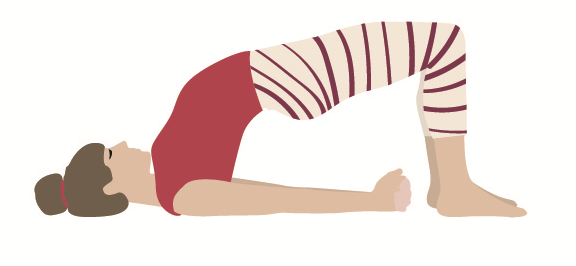
Allow your breathing to guide the practice. Swadhisthana’s water element can inspire smooth transitions, responsive movement and a willingness to adapt each posture to what your body needs today.
Final Thoughts
Swadhisthana marks the point in the chakra journey where physical existence expands into emotional life. Here, we encounter desire, pleasure, creativity, attachment and the feelings awakened through our relationships.
The envy we explored at the beginning may reveal a dream we have left unattended. Feeling stuck may show us where movement is needed. Our emotions can help us recognise what matters, where we need clearer boundaries and what we are ready to change.
Rakini reminds us that a healthy life requires stability and flow. Our foundations give us somewhere steady to stand. Our adaptability allows us to respond when life asks us to move.
Perhaps the final question of Swadhisthana is:
What would help me feel secure enough to move towards what I desire?
The Chakra Journey
Where we began
Mooladhara establishes the foundations of physical life: the body, food, shelter, safety and belonging. Explore the Mooladhara (Root) Chakra.
Where we are now
Swadhisthana introduces our emotional life: desire, pleasure, relationships, creativity and our ability to move with change.
Where we go next
Next week, we move into Manipura, the fire centre. Here, feelings and desires begin to develop into personal power, direction and the ability to act.
Continue Exploring Your Rhythm
The balance between stability and flow reaches far beyond the yoga mat. Sleep, food, movement and rest all influence how steadily we meet the changes in our lives.
This connection is at the heart of Back to Rhythm, my 12-week programme for restoring steadier energy, digestion and emotional balance through daily and seasonal rhythms.
Join the Back to Rhythm list to follow the development of the programme, receive practical reflections and hear first when the September group opens.
FAQs
What is the Sacral Chakra?
The Sacral Chakra, or Swadhisthana, is the second of the seven main chakras in the yogic tradition. It is associated with the water element and relates to emotions, creativity, relationships, pleasure and our ability to adapt to change.
What does a balanced Sacral Chakra feel like?
A balanced Sacral Chakra supports emotional resilience, healthy relationships, creativity and the ability to experience life's ups and downs without becoming overwhelmed or disconnected.
What are the signs of an imbalanced Sacral Chakra?
According to the yogic tradition, an imbalance may show up as emotional reactivity, difficulty expressing feelings, creative blocks, fear of change or feeling disconnected from yourself and others.
How can I balance my Sacral Chakra?
Simple practices include mindful movement, meditation, chanting the VAM mantra, reflective journalling, breath awareness and yoga poses that gently open the hips and pelvis, such as Butterfly, Pigeon and Goddess Pose.
Do I need to believe in chakras to benefit from these practices?
Not at all. Many people find that yoga, meditation and self-reflection help them become more aware of their emotions and respond more calmly to life's challenges, whether or not they view chakras as an energetic system.