5 Reasons to Practise Nadi Shodhana (Alternate Nostril Breathing)
updated September 2026
TL;DR
Nadi Shodhana, or alternate nostril breathing, is a traditional pranayama practice used to balance the flow of breath between the two nostrils.
In Yoga, the right nostril is associated with pingala, the active and warming quality, while the left is associated with ida, the cooling and calming quality.
Regular practice can help settle the mind, balance activity and rest, and prepare you for meditation.
Research into alternate nostril breathing has also found effects on cardiovascular measures such as blood pressure.
You can practise a few comfortable rounds in the morning, after work, before Yoga or meditation, or as part of your evening wind-down.
Prefer to listen?
You can press play below to hear this episode of Rooted in the Seasons, or scroll down to read the blog post.
What is Nadi Shodhana?
If you think about Yoga breathing techniques, which one comes to mind first?
There is a good chance it is Nadi Shodhana, or alternate nostril breathing. It is one of the best-known pranayama practices: breathe in through one nostril, breathe out through the other, then reverse the direction.
It looks almost too simple to have much effect.
Yet Nadi Shodhana has a particular place within the Yoga tradition. The Hatha Yoga Pradipika, one of the classical texts on Hatha Yoga, introduces the practice early in its chapter on pranayama. Its purpose is contained within its name.
Nadi refers to the subtle channels through which prana, our vital life force, is said to move.
Shodhana means purification or cleansing.
So Nadi Shodhana literally means purification of the nadis.
And this gives us the first clue as to why this seemingly simple breathing practice matters. Yoga sees pranayama as part of a progression. We prepare the body through asana. Where needed, cleansing practices help prepare the physical system. Then we begin working more directly with the breath and prana.
Nadi Shodhana helps create the conditions for that next stage.
🌱 The more clearly you recognise what is going on within you, the easier it becomes to choose what might help
Download my free guide:
5 Daily Ayurvedic Shifts to Feel Like Yourself Again
It gives you five simple ways to bring that awareness into everyday life.
How to practise Nadi Shodhana?
Want to practise with me?
Follow this 5-minute guided Nadi Shodhana practice, or use the step-by-step instructions below.
short guided Nadi Shodhana practice to follow along.
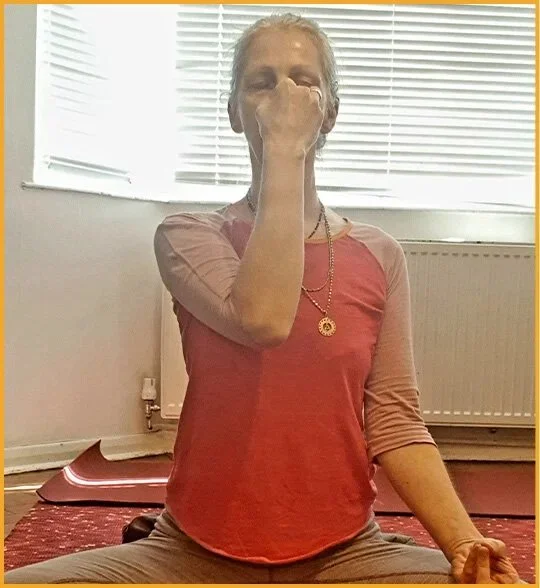
Sit cross-legged, in heel seat or even on a chair.
Keep your spine long.
Bring your right hand to your face and flex your index- and middle fingers.
Place your thumb on your right nostril and ring- and little finger on the left nostril, light touch.
Take a few breaths in the position to let the breath settle.
Close your right nostril, and slowly inhale through the left nostril.
Close the left nostril, open the right one, and exhale slowly.
Inhale right nostril.
Close right nostril, open left nostril.
Exhale through the left nostril.
This is one round.
Continue for as long as it feels good, the right arm doesn't get tired and the breath can flow slowly and steadily.
What are the benefits of Nadi Shodhana?
01. Nadi Shodhana calms the mind
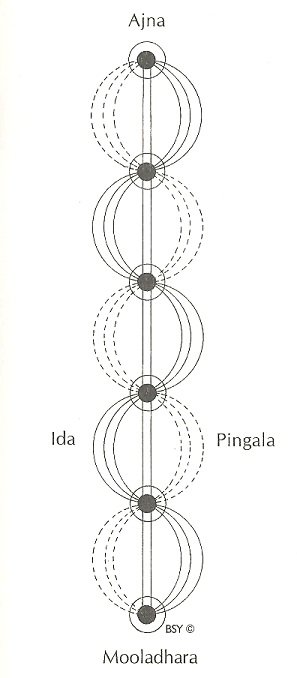
Ida/Pingala
One of the reasons I come back to Nadi Shodhana again and again is the effect it can have on the mind.
When we are busy, stressed or have spent much of the day moving from one thing to the next, the mind often carries that activity with it. We might sit down to practise Yoga or meditate, yet internally we are still planning, processing and thinking.
Nadi Shodhana gives the mind something very simple to follow: breathe in through one nostril, breathe out through the other, reverse the direction and continue.
The breath gradually becomes slower and steadier. Attention stays with the movement of the breath from side to side. After a few rounds, you may notice that the mind begins to settle with it.
This makes Nadi Shodhana particularly useful when you want to create a transition between different parts of your day — after work, before your Yoga practice, before bed or before sitting for meditation.
02. Nadi Shodhana balances activity and calm
If you pay attention to your breath during the day, you may notice that the airflow through your nostrils is rarely exactly equal. Usually, one nostril is more open or dominant than the other, and this changes naturally throughout the day.
In Yoga, the two nostrils are associated with two of the main nadis, or energy channels. If the idea of prana, nadis and the subtle body is new to you, I explain how these fit together in Understand Yourself Better: A Yogic Map of Body, Energy and Mind.
Pingala nadi is associated with the right nostril and solar energy. It represents the more active, warming and outward-moving qualities we need to think, act, work and get things done.
Ida nadi is associated with the left nostril and lunar energy. It represents the cooling, calming and inward-moving qualities that allow us to rest, reflect and settle.
Nadi Shodhana alternates the breath between these two sides. After practising, you may notice that the breath flows more evenly through both nostrils.
In the Yoga tradition, this more balanced flow is associated with sushumna nadi, the central channel. It represents a state in which neither the active nor the calming quality dominates.
This is also why Nadi Shodhana is such useful preparation for meditation. We are looking for a mind that is alert enough to remain present and settled enough to stay still. Nadi Shodhana helps create the conditions for that middle ground.
This makes the practice useful at different times of day. In the morning, it can help establish a steady starting point before the activity of the day begins. In the evening, it can help the system move towards rest after hours of activity.
03. Nadi Shodhana supports the heart, lungs and nervous system
When we practise Nadi Shodhana, we deliberately change the way we breathe. The breath usually becomes slower, steadier and more controlled than our everyday breathing.
This involves the diaphragm, our main breathing muscle, as well as the intercostal muscles between the ribs. With regular pranayama practice, we become more familiar with allowing the breath to move slowly and fully, and with controlling its rhythm.
The effects reach beyond the breathing muscles. Our breath, heart rate and nervous system continually influence one another.
Research into alternate nostril breathing is also beginning to give us a clearer picture of its physiological effects. A 2024 systematic review and meta-analysis specifically examining alternate nostril breathing and blood pressure included 14 studies with results from 1,377 participants. The researchers found reductions in systolic and diastolic blood pressure, although they also noted considerable variation between the studies and the need for further high-quality research.
As our pranayama practice develops, we can also work with different breathing ratios. We might make the exhalation longer than the inhalation, keep the inhalation and exhalation equal, or introduce pauses after the breath.
Each changes the experience of the practice.
This is one reason pranayama is traditionally taught gradually. We first establish a comfortable, steady breath. More complex ratios and breath retention can then be introduced when the body and nervous system are ready for them.
04. Nadi Shodhana prepares us for other pranayama practices
Nadi Shodhana also has an important place within the traditional progression of pranayama.
The Hatha Yoga Pradipika introduces the purification of the nadis before moving on to other pranayama techniques. The text describes practising alternate nostril breathing regularly and states that after three months the nadis become purified.
Remember what the name tells us: nadi refers to the subtle channels through which prana moves, while shodhana means purification or cleansing.
Once this foundation has been established, the Hatha Yoga Pradipika moves on to other pranayama practices, including Surya Bhedana, which works with the solar or right side, Ujjayi, Bhastrika and Bhramari.
There is a progression here that I find important.
We learn to sit steadily. We become familiar with the breath. We practise directing it consciously from one side to the other. Gradually, we develop the steadiness and awareness needed for more advanced pranayama practices.
Nadi Shodhana therefore becomes more than a breathing technique we use when we want to feel calmer. It creates a foundation for working more deeply with the breath and prana.
05. Nadi Shodhana prepares the mind for meditation
Have you ever sat down to meditate only to discover how busy your mind actually is?
In the evening, it might still be processing conversations and events from the day. In the morning, it may already be planning what needs to happen next.
This is where Nadi Shodhana can help.
For a few minutes, we give the mind one clear point of focus: the breath moving from one nostril to the other. The breath gradually becomes slower and steadier, and attention begins to settle with it.
In the traditional Yoga system, this progression makes sense. Pranayama comes before pratyahara, the drawing of the senses inward, and dharana, concentration. We gradually move from working with the body to the breath, the senses and finally the mind.
After a few rounds of Nadi Shodhana, you may notice that sitting still requires less effort. The mind can feel clearer and more settled, while you remain awake and attentive.
This is the state we are looking for as we move towards meditation: steady, present and alert.
Final Thoughts
Nadi Shodhana is a simple practice, yet there is a reason it has such an important place within the Yoga tradition.
By alternating the breath between the two nostrils, we work with the balance between activity and rest. The breath becomes steadier. The mind has something clear to focus on. And gradually, the whole system has an opportunity to settle into a more balanced state.
This reflects the progression we find throughout Yoga. We begin with the body, move towards the breath and prana, and gradually prepare the mind for concentration and meditation.
You can practise Nadi Shodhana in the morning before the activity of the day begins, after work when you need a transition, before your Yoga practice, or in the evening as you prepare for rest.
Sometimes just a few rounds are enough to notice a change.
Next time you practise, pay attention to your breath before you begin. Which nostril feels more open? Then check again afterwards.
What do you notice?
FAQs
How long should I practise Nadi Shodhana?
If you are new to the practice, begin with just a few comfortable rounds. Continue while the breath remains smooth and steady and your arm feels comfortable. With experience, you can gradually practise for longer.
When is the best time to practise Nadi Shodhana?
Nadi Shodhana can be practised at different times of day. In the morning, it can help you begin from a steadier place. After work, it can create a transition out of the activity of the day. It is also particularly useful before meditation or as part of an evening Yoga practice.
Can I practise alternate nostril breathing every day?
Yes. Nadi Shodhana is traditionally practised regularly and can become part of a daily pranayama practice. Keep the breath comfortable and unforced, particularly when you are beginning.
Does Nadi Shodhana help with stress and anxiety?
The slower, more deliberate breathing used in Nadi Shodhana may help the body and mind settle, and research into alternate nostril breathing has found effects on measures associated with autonomic and cardiovascular function. If you are experiencing persistent or severe anxiety, breathing practices can form part of your support alongside appropriate professional care.
Should I hold my breath during Nadi Shodhana?
You don't need to hold your breath when you are learning Nadi Shodhana. Begin by allowing the inhalation and exhalation to flow comfortably from one side to the other. Breath retention and more complex ratios belong to a more developed pranayama practice and are best introduced gradually.